Two Related articles :
- Three Turns Inside HELIX: How the Loop Actually Runs
- 2. 118 Turns to Retire a 22-Year-Old Inventory System: A PM’s HELIX Delivery Report
The complete methodology in one read — the model, the principles, the seven phases, the risk tiers, the planes, the roles, and the numbers that keep it honest. Written for the people who will actually run it.
Every lifecycle we’ve ever worked in — waterfall, agile, DevOps — was built on one economic fact: writing code is expensive. Guard the writing and quality follows. That fact is gone, and the industry data is blunt about what happens next:
- AI-assisted pull requests carry roughly 68% more review findings than human-only ones (10.8 vs 6.5 per PR).
- Gartner projects AI coding costs passing an average developer’s salary by 2028.
- 97% of AI-related breaches trace to unauthorized access — usually an over-permissioned agent nobody was watching.
Here’s the reframe that matters for engineers: unreviewed throughput isn’t velocity. It’s inventory — a warehouse of unverified risk that somebody eventually pays to unload.
HELIX is a lifecycle rebuilt around that reality. The bottleneck moved from writing code to trusting it, so the process reorganizes around verification. This article is the whole method, end to end.
The model: two strands, bound by verification
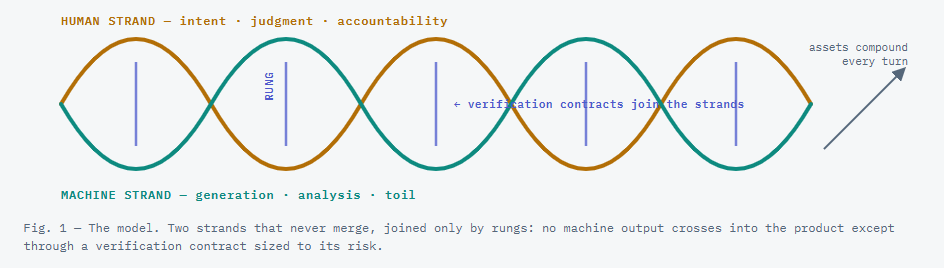
Picture a double helix.
- The human strand — intent, judgment, accountability. What to build, why it matters, what “good” means. Never delegated to a model.
- The machine strand — generation, analysis, migration, test-writing, toil. Executed by AI agents at scale, always inside explicit guardrails and scoped permissions.
- The rungs — verification contracts joining the strands. No machine output becomes part of the product without crossing a rung sized to its risk.
- The rise — each turn of the loop deposits reusable assets (specs, evals, guardrails, skills), so every next turn is faster, cheaper and safer. The loop climbs; it doesn’t circle.
If you want it in one line: iterative cadence, hard gates, machine-priced checks. Agile’s rhythm with the discipline waterfall always promised and never delivered — affordable now, because machines run the gates.
Six principles before any process
- Intent is the source of truth. Specs, not code, carry the project. Code is a build artifact you can regenerate; intent is the thing you protect and version. When code and spec disagree, the spec is the one that gets fixed deliberately.
- Trust is earned per change. No output is trusted because a model is “usually right.” Usually-right is exactly the trap — it’s why review discipline decays two months into every AI rollout.
- Autonomy is risk-tiered. How much freedom an agent gets is an explicit classification agreed before work starts — never a vibe, never a deadline concession.
- Humans judge, machines toil. People own decisions, trade-offs and accountability. Agents own repetitive execution at scale. Neither does the other’s job.
- Security rides every phase. Not a pre-release audit. Scoped agent identities, scanned outputs and threat-modeled specs from the very first turn.
- Every turn pays for itself. Cost per verified change is a first-class metric. Defects become evals, decisions become policy, and work routes to the cheapest model that clears the gate.
If your team internalizes only one of these, make it the second. Everything else in HELIX is machinery to make trust-per-change affordable.
The loop: one turn of the helix
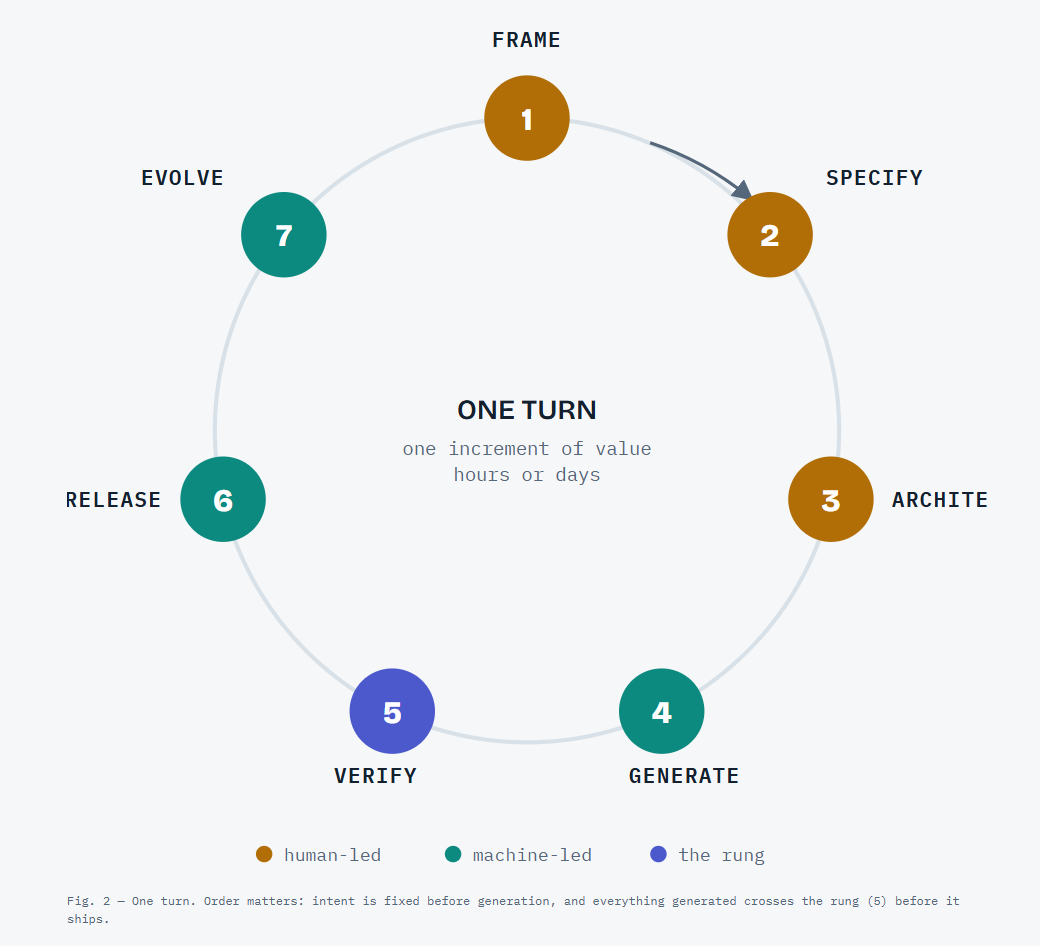
A turn is one small increment — a feature slice, a fix, a refactor. Most turns take hours or days, not weeks. Seven phases, each with a gate. Phases 1–3 are human-led and cheap. Phase 4 is machine-led. Phase 5 is the rung. Phases 6–7 close the loop and compound it.
1 · Frame (human-led, ~half a day)
State the outcome in plain language, classify the risk tier (R0–R3), and set the budget envelope — time and tokens.
- Produces: an intent brief a director can read in two minutes; a tier; a budget.
- Gate: human sign-off on intent and tier. No tier, no work.
This phase prevents the most expensive failure in AI-first development: building the wrong thing at machine speed.
2 · Specify (human-led, 1–2 days)
Turn intent into an executable specification — behavior, testable acceptance criteria, abuse cases, and the “must never” rules. Write criteria in structured plain language (“When X and Y, the system shall Z”) so product owners can review them and agents can implement against them. Then the move that feels strange the first time: an AI red-teams your spec, hunting ambiguity, missing edge cases and unstated assumptions before any code exists.
- Produces: a versioned spec; abuse cases; constitution updates.
- Gate: humans arbitrate the spec; red-team findings are resolved, not waved through.
Ambiguity killed at spec time is the cheapest defect you will ever fix.
3 · Architect (human-led, 1–2 days)
Decide structure once, deliberately, so a hundred generated diffs can’t erode it. Agents draft design options with trade-offs; humans choose and record ADRs.
- Produces: ADRs; interface contracts; a verification plan (what proof this change owes); agent permission scopes for the turn.
- Gate: design review — plus a threat model for R2 and above.
4 · Generate (machine-led, days)
The machine strand takes over. Work is decomposed into atomic, independently verifiable tasks — an agent never holds the whole feature in its head, and no diff arrives too big to verify. Engineers act as navigators: curating context, steering, unblocking. Agents run on least-privilege, time-boxed credentials; they propose, they never deploy.
Before any human sees a diff, it passes the machine gate:
- Tests green against the spec’s acceptance criteria
- Static analysis, dependency (SCA), secret and license scans clean
- Spec-conformance self-check passed
- Style, lint and contract conformance verified
- Provenance label attached: which agent, which model, which spec section
The rule that keeps review humane at AI speed: humans never spend attention on what a machine can reject.
5 · Verify (the rung — the load-bearing phase)
Verification capacity is engineered like production capacity — reviews must run at the speed of generation, or the pipeline silts up and pressure builds to rubber-stamp. Three layers, cheapest first:
- L1 — Machine gate (all tiers): deterministic checks on everything, always. Effectively free.
- L2 — Adversarial AI review (R1+): a different model than the author, prompted to refute — drift from spec, hidden coupling, insecure patterns, missing edge cases. A reviewer prompted to refute finds what a reviewer prompted to approve never will.
- L3 — Human intent review (depth by tier): intent-conformance, architecture, risk — not line-by-line style, which the gate already enforced.
Two absolutes:
- The author never verifies their own change. Not engineers. Not agents.
- No record, no merge. Every merge carries a verification record — what was checked, by whom, by what. That record is the warranty card on the change, and six months later it’s your audit trail.
6 · Release (progressive by default)
- Flags, canaries, staged rollout — blast radius sized to the tier.
- Telemetry watches behavioral drift, not just errors: many individually “correct” changes can still bend the product.
- Alerts trigger agent-drafted root-cause analysis; humans approve remediation on sensitive paths.
- Rollback is a rehearsed, first-class path — never an improvisation.
- For anything that automates a decision (pricing, replenishment, scheduling): shadow mode first. Let the new system recommend silently alongside the old process, and read the disagreement log with your domain experts before a single real transaction moves.
7 · Evolve (half a day, forever)
The turn retro reads three numbers: escaped defects, verification hit-rates, cost per verified change. Then the ratchet:
- Every escaped defect becomes a permanent eval, guardrail or spec clause. A defect class gets to fool you exactly once.
- Prompts, skills, evals and the constitution are curated as versioned assets — reviewed, pruned, improved like code.
- Overpriced models get demoted; flaky checks get retired; what didn’t pay gets deleted.
Skip this phase and HELIX degrades into ordinary agile with expensive typing. Run it and the loop compounds: the same team, six months in, ships the same class of change at half the cost with a fraction of the escapes.
Risk tiers: autonomy is earned by consequence
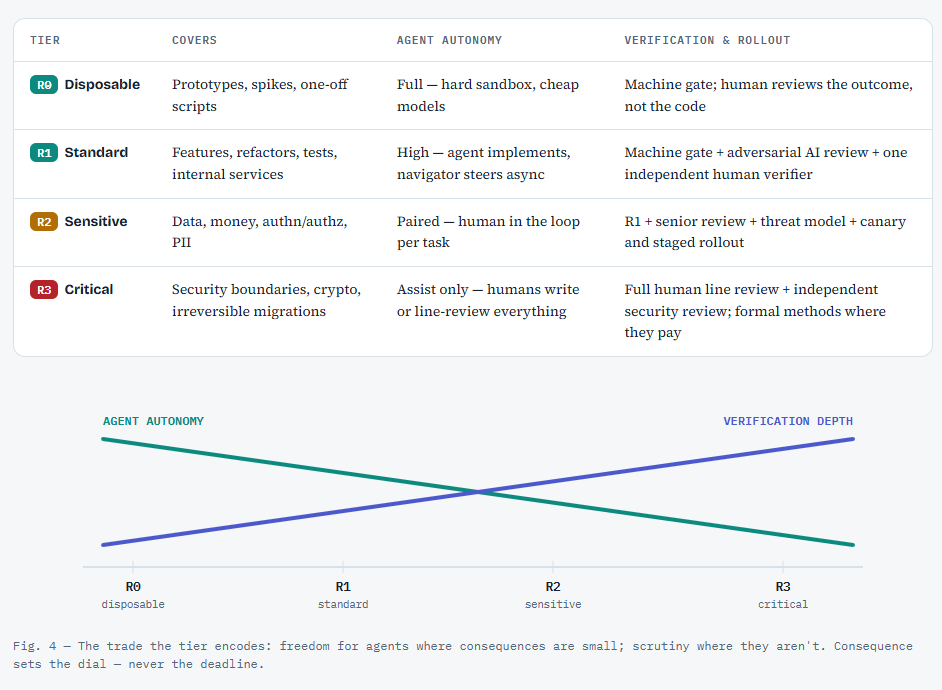
Every piece of work gets a tier at Frame, and the tier — not the deadline, not the model’s benchmark scores — sets agent freedom, verification depth and rollout caution.
| Tier | Covers | Agent autonomy | Verification & rollout |
|---|---|---|---|
| R0 · Disposable | Prototypes, spikes, one-off scripts | Full, in a hard sandbox, cheap models | Machine gate; human reviews the outcome, not the code |
| R1 · Standard | Features, refactors, tests, internal services | High — agent implements, navigator steers async | Machine gate + adversarial AI review + one independent human verifier |
| R2 · Sensitive | Data, money, authn/authz, PII | Paired — human in the loop per task | R1 + senior review + threat model + canary and staged rollout |
| R3 · Critical | Security boundaries, crypto, irreversible migrations | Assist only — humans write or line-review everything | Full human line review + independent security review; formal methods where they pay |
Two rules make tiering real:
- Tier follows the code path, not the ticket. A “quick fix” that touches an R3 file is R3 work, whatever the sprint board says.
- The verifier can re-tier any change on sight, and re-tiers are audited — deadline pressure always pushes work downhill, so the counterweight has to be structural.
Four planes that run through every phase
Phases are when things happen. Planes are always-on rails, stewarded by the platform role and used by everyone.
- Quality — the eval suite that grows from every defect; coverage and mutation thresholds by tier; first-pass acceptance tracked per agent.
- Security — least privilege for people and agents: named agent identities with full audit logs; the scan-everything gate; human approval for high-impact actions at every tier; injection-aware tooling that treats everything an agent reads as untrusted input.
- Cost — token budgets set at Frame; model routing by task class; cost per verified change reviewed in every retro.
- Knowledge — the team’s memory, versioned in git: constitution, spec library, skills, prompts, ADRs. Onboarding a new engineer — or a new agent — is reading the planes.
What changes for you
Nobody on a HELIX team “just writes code,” because writing code is no longer the scarce activity. The work rearranges into four roles — roles, not job titles; one person may wear several hats, and the only forbidden combination is author and verifier of the same change.
| Role | Who | Owns | Answers for |
|---|---|---|---|
| Intent Owner | PM + tech lead | Frame, Specify | “We built the right thing.” |
| Navigator | Engineers | Steering agents: decomposition, context, unblocking, taste | “It was built well.” |
| Verifier | Rotating duty, weekly | The rung — always independent of the author | “It is proven.” |
| Steward | Platform engineers | The four planes: gate, identities, dashboards, assets | “The system holds.” |
And the agents? Team members with the least trust, not the most: named, scoped, logged, benchmarked — and rolled back like any bad deploy when their acceptance rate drops.
The honest career note: the market stopped paying a premium for typing speed the day agents learned to type. Specification, decomposition, verification and judgment were always the hard parts of this craft. HELIX is the first lifecycle that says so out loud — and staffs accordingly.
Guarantees you can put to the test
HELIX promises a lot: quality, predictability, adaptability, collaboration, risk management, security, cost-effectiveness. Promises are cheap, so the methodology holds itself to a harder standard — every promise must come with a mechanism that enforces it at a gate, a metric that would expose its failure early, and a designed counter for its residual risk.
| Guarantee | Enforced by | Failure shows up as |
|---|---|---|
| High quality | Machine gate + adversarial review + eval ratchet | Escape rate ↑, first-pass acceptance ↓ |
| Predictable | Fixed gates; tier sets effort at Frame; budget envelopes | Verification latency ↑, budget variance ↑ |
| Adaptable | Change = spec diff + regeneration under the eval net | Spec-to-shipped lead time ↑ |
| Collaborative | Shared specs/ADRs/records; gates require a second named party | Merges without independent verifier |
| Risk-managed | R0–R3 binds autonomy and blast radius to consequence | Any R3 escape; re-tier rate ↑ |
| Security-first | The security plane, every phase | Coverage < 100%; out-of-scope agent action |
| Cost-effective | Budgets at Frame; model routing; cost per verified change | Cost per change trending ↑ |
And the honest part — three guarantees are conditional, and the methodology says so:
- Predictability depends on actively managing verification capacity. That’s why latency is first-class, with a mandated remedy: add verification capacity, never more generation.
- Collaboration is process-enforced rather than machine-enforced — but the gates literally require a second named party, which is as hard as process enforcement gets.
- Cost-effectiveness arrives after the platform investment, not on day one.
The claim was never "can’t fail." The claim is: fails loudly, locally, and with a known fix.
Six numbers keep it honest
| Metric | Direction | When it moves the wrong way |
|---|---|---|
| First-pass acceptance | ↑ | Specs are vague — fix Specify, not the agent |
| Verification latency | ↓ | A queue is forming — add capacity, never more generation |
| Defect escape rate (by tier) | ↓ | Any R2/R3 escape triggers a mandatory Evolve action |
| Provenance coverage | 100% | Anonymous code is accumulating — stop and fix the pipeline |
| Cost per verified change | ↓ | Routing, spec quality or rework is drifting — read the retro |
| Asset yield | ↑ | The loop is circling, not climbing — Evolve is being skipped |
Notice the pattern: each metric names its own remedy. The dashboard doesn’t just tell you something’s wrong — it tells you which phase to fix.
Start smaller than you think
Adopt in three gears:
- Crawl — one squad, low-risk work only; machine gate and agent identities stood up; a one-page constitution; all six metrics baselined.
- Walk — tier the whole backlog; adversarial review on everything above R0; budgets and model routing on; retros feeding the eval suite.
- Run — fleet supervision on routine work; agents drafting RCAs in the ops loop; sensitive work paired by default; cost per verified change trending down.
Your first week is four moves:
- Pick the pilot squad.
- Tier its current backlog.
- Turn on scan-everything.
- Draft constitution v1 — one page is enough.
Four turns later, you’ll have evidence instead of opinions — and the four-turn review is where this stops being a slide deck and starts being your process.
The point
Agile taught us to ship small and learn fast. HELIX keeps both, and adds the thing agile never had to promise because humans were the only authors: proof.
Two strands. A rung every change must cross. A loop that leaves you faster, safer and cheaper than the turn before.
The best engineers were never really paid for typing. Now the lifecycle finally agrees.
#AIFirstSDLC #SoftwareEngineering #SDLC #EngineeringExcellence #AIAgents


Leave a comment